A solar eclipse is one of nature’s most striking visual spectacles—a moment when the Moon moves between the Earth and the Sun, temporarily blocking some or all of the Sun’s light. For centuries, solar eclipses have inspired awe, fear, scientific curiosity, and cultural storytelling. Today, they remain powerful reminders of the precise celestial mechanics that govern our solar system.
What Causes a Solar Eclipse?
Solar eclipses occur when the Moon’s orbit carries it directly between the Earth and the Sun during a new moon phase. Despite the Sun being about 400 times larger than the Moon, it is also about 400 times farther away, allowing the Moon to appear nearly the same size in the sky. This coincidence makes total solar eclipses possible.
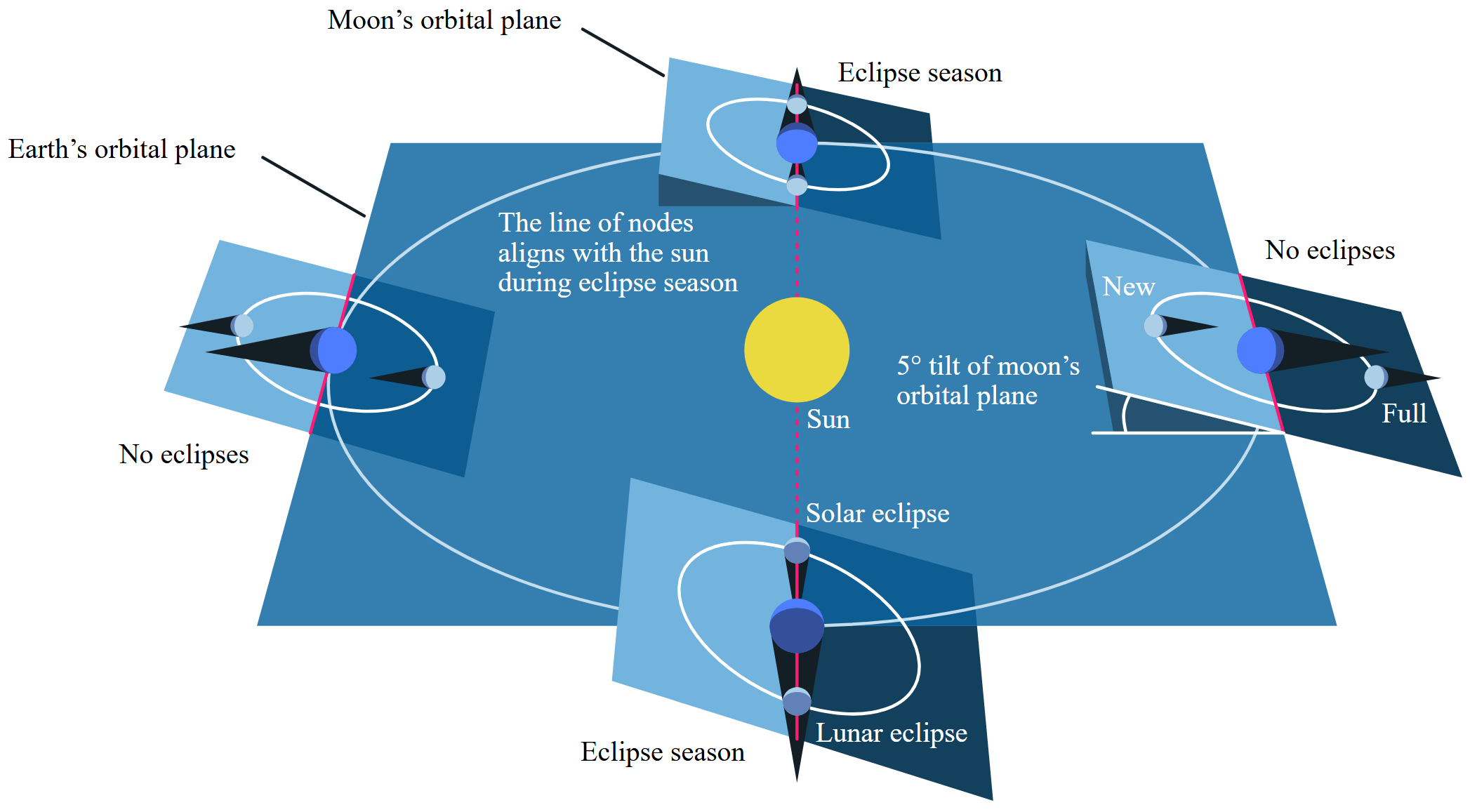
However, eclipses do not happen every month. The Moon’s orbit is tilted about 5 degrees relative to Earth’s orbit around the Sun. Most months, the Moon passes slightly above or below the Sun from our perspective. Only when the orbits align precisely does an eclipse occur.
Types of Solar Eclipses
There are four main types of solar eclipses, each offering a different viewing experience:
Total Solar Eclipse
A total solar eclipse happens when the Moon completely covers the Sun. During totality, the sky darkens dramatically, stars may appear, and the Sun’s outer atmosphere—the corona—becomes visible. This phase can last only a few minutes at any given location.
Partial Solar Eclipse
In a partial eclipse, the Moon blocks only part of the Sun. These eclipses are more common and can be seen over a much wider area, though they lack the dramatic darkness of totality.
Annular Solar Eclipse
An annular eclipse occurs when the Moon is farther from Earth and appears slightly smaller than the Sun. This results in a glowing “ring of fire” surrounding the Moon.
Hybrid Solar Eclipse
A rarer event, a hybrid eclipse appears as a total eclipse in some locations and an annular eclipse in others, depending on the viewer’s distance from Earth’s curvature.
The Path of Totality
One of the most fascinating aspects of a total solar eclipse is its path of totality—a narrow corridor, often only about 100 to 200 kilometers wide, where the total eclipse is visible. Outside this path, observers see only a partial eclipse.
Because of Earth’s rotation and the Moon’s motion, the path sweeps across the planet at high speed. Experiencing totality requires being in exactly the right place at exactly the right time, which is why eclipse travel has become a global phenomenon.
A History of Awe and Discovery
Throughout history, eclipses were interpreted as omens or messages from the gods. Ancient Chinese records mention dragons devouring the Sun, while some civilizations viewed eclipses as warnings of political or natural upheaval.
In modern times, eclipses have advanced science. The 1919 total solar eclipse famously helped confirm Albert Einstein’s theory of general relativity by demonstrating how the Sun’s gravity bends starlight. Even today, eclipses provide rare opportunities to study the solar corona and space weather.
Experiencing an Eclipse Safely
Looking directly at the Sun without protection can cause serious and permanent eye damage. Except during the brief moments of totality, proper eye protection is essential.
Safe viewing methods include:
- ISO‑certified eclipse glasses
- Pinhole projectors
- Certified solar filters for telescopes and cameras
Regular sunglasses are not safe for eclipse viewing.
Why Solar Eclipses Still Matter
In an age of constant screens and digital distractions, solar eclipses have a unique power to unify people in shared attention. Cities pause, classrooms step outside, and strangers gather, all looking up at the same sky. For designers, educators, and storytellers, eclipses offer a rich metaphor for alignment, timing, and transformation—moments when the ordinary briefly gives way to the extraordinary.
Comments1
Fake Comment
Why can't I stare at the sun?